Building Secure AI Workflows for Healthcare: Private Clinical Data Extraction & Reliability
Healthcare organizations are under enormous pressure to use AI to improve productivity and decision-making, but not at the expense of privacy, accuracy, or trust.
Clinical data is deeply sensitive. Physician notes are nuanced. Patient records are fragmented. And generic, prompt-based AI systems are often too opaque, too risky, or too inaccurate for real clinical workflows.
GLiNER makes it possible for healthcare teams to build a secure, private, and reliable AI workflow for structuring clinical text without sending protected health information (PHI) outside their environment.
The Core Problem: Clinical Data Is Valuable, Sensitive, and Unstructured
Most clinical insight lives in free-text documents such as:
Physician progress notes
Intake summaries
Discharge notes
Referral letters
Patient medical records
Insurance claims
These documents contain critical information like diagnoses, symptoms, medications, procedures, and follow-up instructions. However, they are not structured in a way AI can reliably use and healthcare teams face competing requirements:
Privacy: PII and PHI must remain protected and compliant with HIPAA and internal policies
Accuracy: Clinical data extraction must be precise and deterministic
Usability: Structured outputs must integrate cleanly into internal systems
Cost: Long clinical notes and re-processing historical records becomes prohibitively expensive
Many AI approaches struggle to meet all of these requirements, often forcing tradeoffs between accuracy, speed, usability, and cost.
Why LLM-First Approaches Fall Short in Healthcare
Large language models are powerful, but in healthcare environments they introduce real challenges:
Data handling risk: Sending notes to external APIs may violate privacy or compliance requirements
Non-deterministic output: The same input can yield different results, unacceptable for clinical workflows
Over-extraction: LLMs often infer or hallucinate beyond what’s explicitly written
Unexplainability: It’s difficult to explain why a specific piece of information was extracted
For healthcare operations, reliability and control matter more than open-ended generation.
How GLiNER models Enable Accurate and Secure AI in Healthcare
GLiNER is a lightweight encoder model designed for structured extraction, not free-form generation. Key characteristics that make it suitable for healthcare use cases:
Runs entirely in private environments (on-prem or private cloud)
PII redaction to support safe storage, sharing, and analytics
Schema-based extraction ensures deterministic, explainable outputs
Efficient CPU inference supports batch ingestion and real-time workflows with 50-100ms inference time
Zero-shot extraction with optional fine-tuning enables accurate handling of niche, rare, and organization-specific medical terminology
Example: Structuring Physician Notes + Patient Medical Records
Input Sources
Physician progress notes
Patient longitudinal medical records
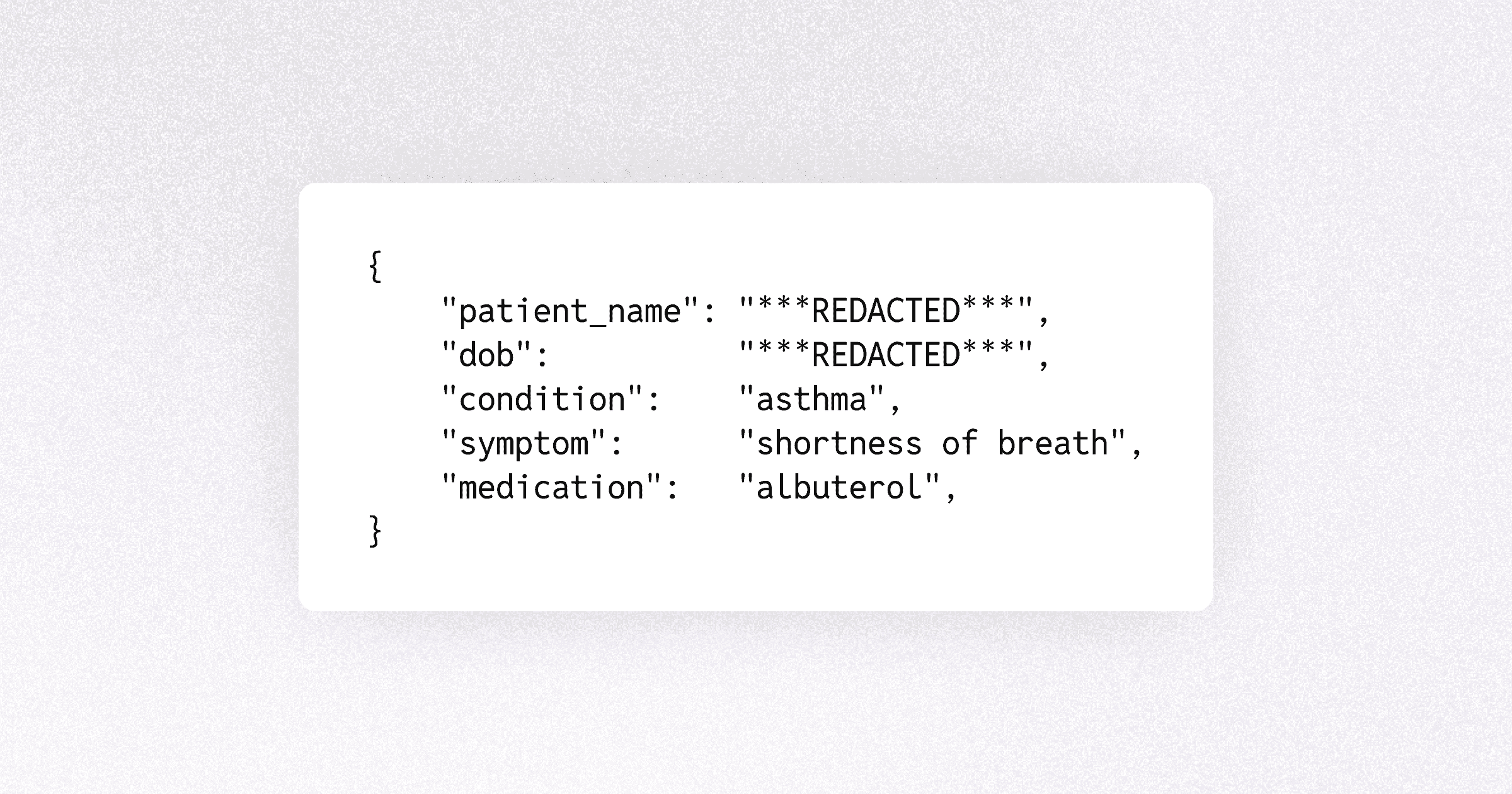
Example input (simplified):
“Patient reports worsening shortness of breath. History of asthma. Prescribed albuterol inhaler. Follow up in two weeks.”
Clinical Extraction Schema
condition
symptom
medication
dosage
procedure
follow_up_instruction
What Gets Extracted
The output doesn’t include speculation and doesn’t infer an incorrect diagnosis. Each extracted entity includes a confidence score, enabling threshold-based decisions and auditable workflows.
Secure AI That Fits Healthcare Requirements
Healthcare organizations don’t need AI that tries to do everything. They need AI that does that delivers predictable accuracy, preserves patient privacy, and scales economically. With GLiNER, teams can increase productivity without compromising privacy or accuracy.
Learn more about GLiNER’s capabilities