Research
Mary Newhauser

"American open weight models" is a phrase that would have sounded strange not long ago. For years, the most capable models in the United States came from a few labs, and building with AI meant building on what those few offered. But the market is changing. In July, more than two hundred organizations, Fastino Labs among them, signed an industry letter making the case for open weights as a foundation of American AI. The question facing the country now is whether the very place where the term "open source" was first coined will become a land of open weights.
We believe that open weight models present America with a set of interconnected opportunities: to catalyze innovation through openness and collaboration with labs around the world, to widen who gets to build with AI, and to create a diversity of models that spans not only open and closed but also large and small.
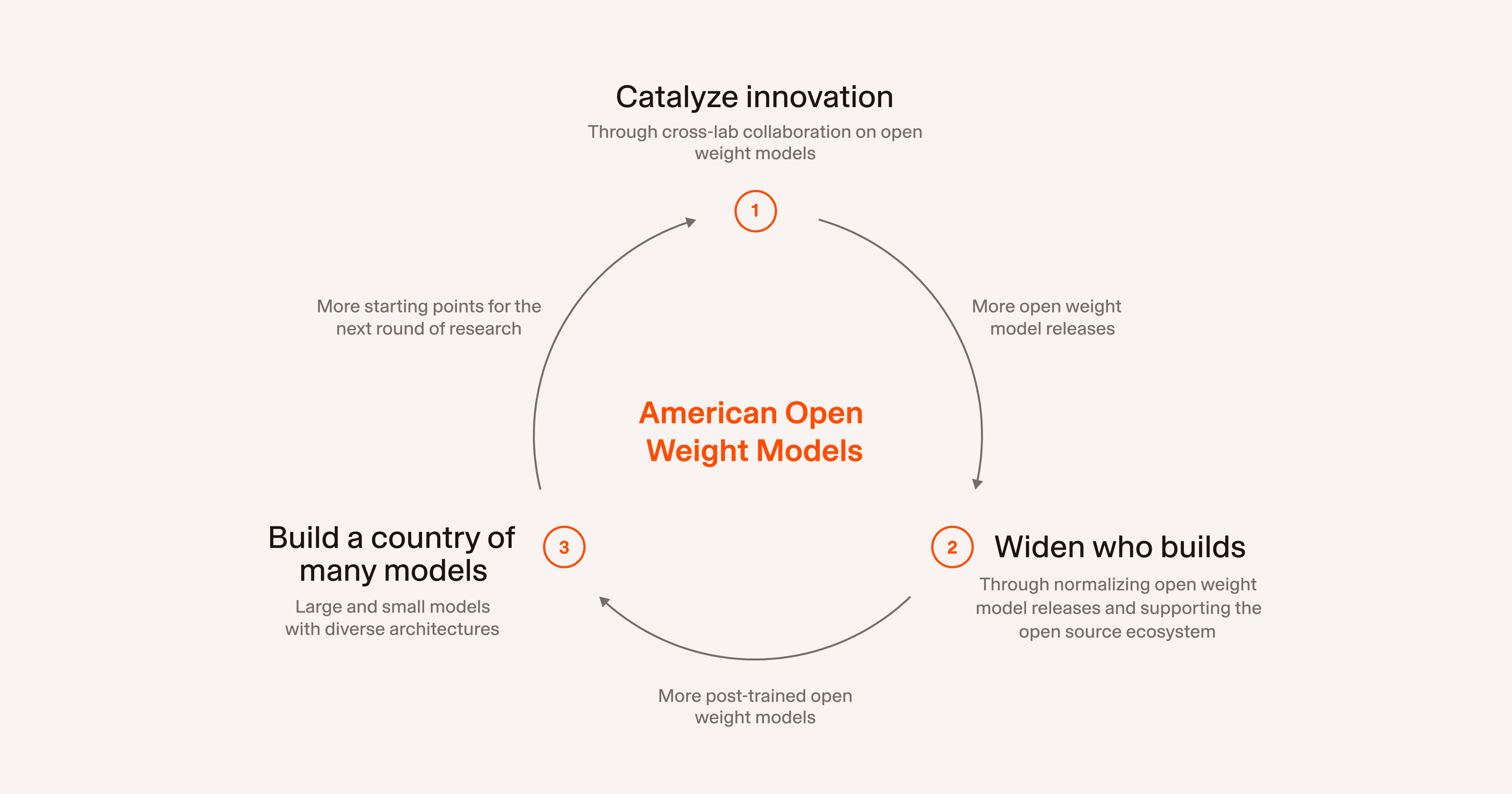
Open weights accelerate progress by giving labs and organizations a starting point to adapt and improve in parallel, expanding access to strong models beyond the few able to train them from scratch. This, in turn, leads to the creation of a wide array of open weight models, so that builders can choose the model that fits the task, domain, and constraints rather than the largest one available.
Championing open weight models ultimately allows America to be the land of many models for the many, as opposed to a land of few models for the few. In this post, we lay out the opportunity ahead, what it looks like, and how we can get there.
To catalyze innovation through openness and collaboration with frontier labs
Machine learning moves forward when one team can pick up where another left off, and open weights are what make that possible today. Pre-training gives a model broad knowledge; post-training adapts it to a task or domain. Done on an open weight base, post-training lets teams without frontier-scale compute produce models competitive with far larger ones on targeted tasks.
The record of the past three years demonstrates the value gained when labs collaborate on open weight models. In March 2023, a team at Stanford fine-tuned Meta's LLaMA 7B on 52,000 instruction examples for under $600 of compute and released Alpaca, a capable instruction-following model built entirely on another lab's weights. The techniques that made it affordable, LoRA from Microsoft Research and QLoRA from the University of Washington, came from that same American research tradition, in which universities and research labs publish methods and industry supplies models at scale.
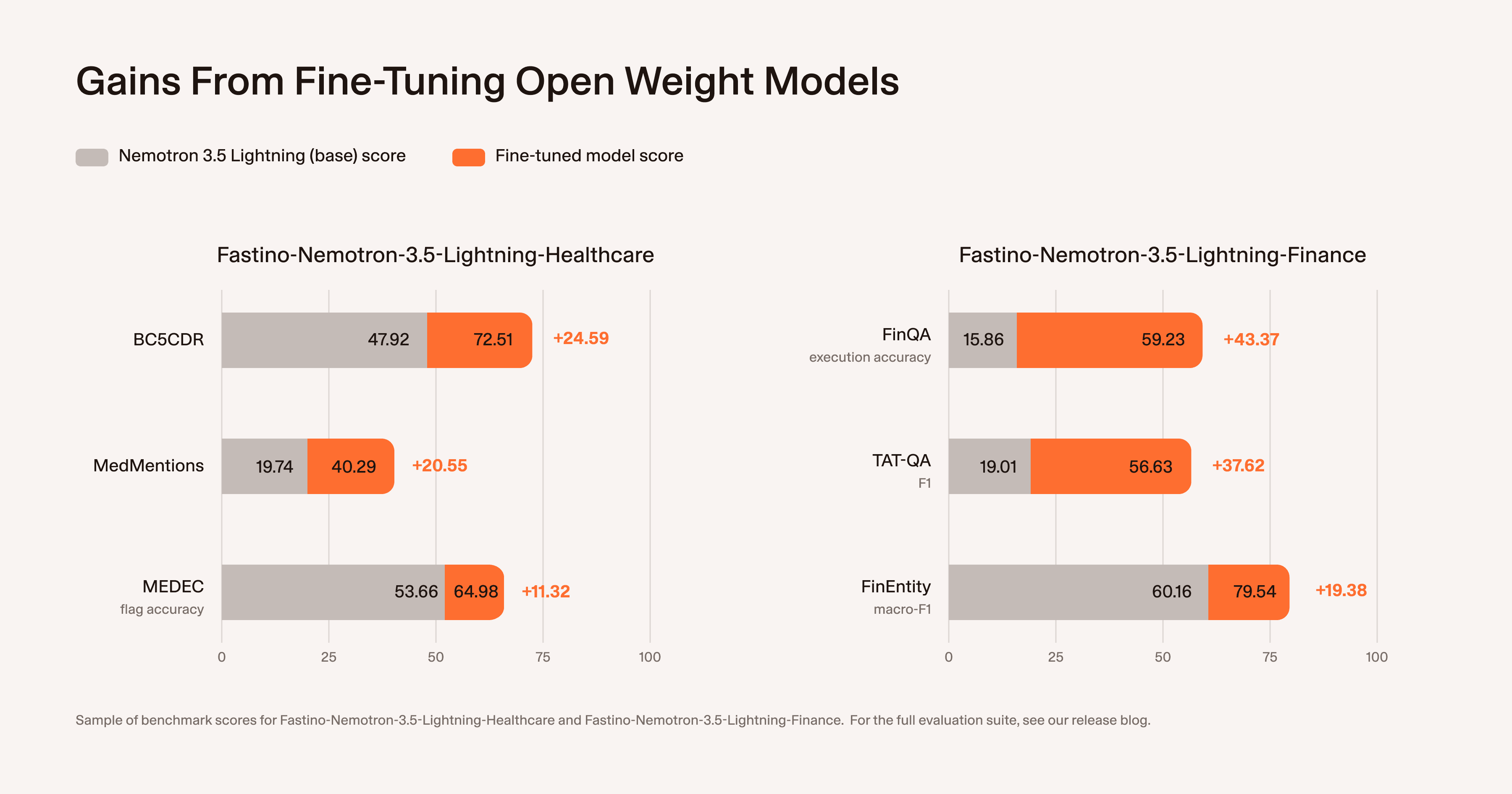
Our own collaboration with NVIDIA's Nemotron team shows how this works in practice today. We used an advanced agent to fine-tune two models from an early access Nemotron 3.5 Lightning checkpoint: one for healthcare and one for finance. The resulting models, which are also open weight, lifted FinQA execution accuracy from 15.86% to 59.23% and MedCalc-Bench from 49.09% to 54.18% over the base model. This work required no pre-training compute and no access to NVIDIA's data, only the shared checkpoint and our fine-tuning agent, which is exactly how one lab takes another's open weight base and improves it for the domains that matter to its users. In the spirit of openness, we also shared the ten best fine-tuning recipes our agent discovered as well as other lessons learned for optimal fine-tuning of Nemotron 3.5 Lightning.
Open weight model checkpoints are the vehicle through which knowledge circulates, and fine-tuning is the mechanism where knowledge compounds. What starts as a single released checkpoint can become a family of models, post-trained, distilled, quantized, or otherwise adapted by anyone who chooses to build on it. This makes it possible for users without access to large-scale compute and massive training datasets to train and adapt models for their specific needs. That widening of who gets to build is the second stage of the opportunity.
To widen who gets to build with AI
Who gets to build with AI has so far been decided by who could afford to train a model. However, the explosion of high-quality open weight models we’ve seen in recent months is changing this. Open weight models are fully adaptable and customizable by users; closed proprietary models are not. An American organization fine-tuning a model on its own data, under its own regulatory constraints, in its own private cloud ought to be unremarkable. Making it so, and thereby widening who gets to build with AI, requires normalizing open weight releases and supporting the shared software ecosystem those releases depend on.
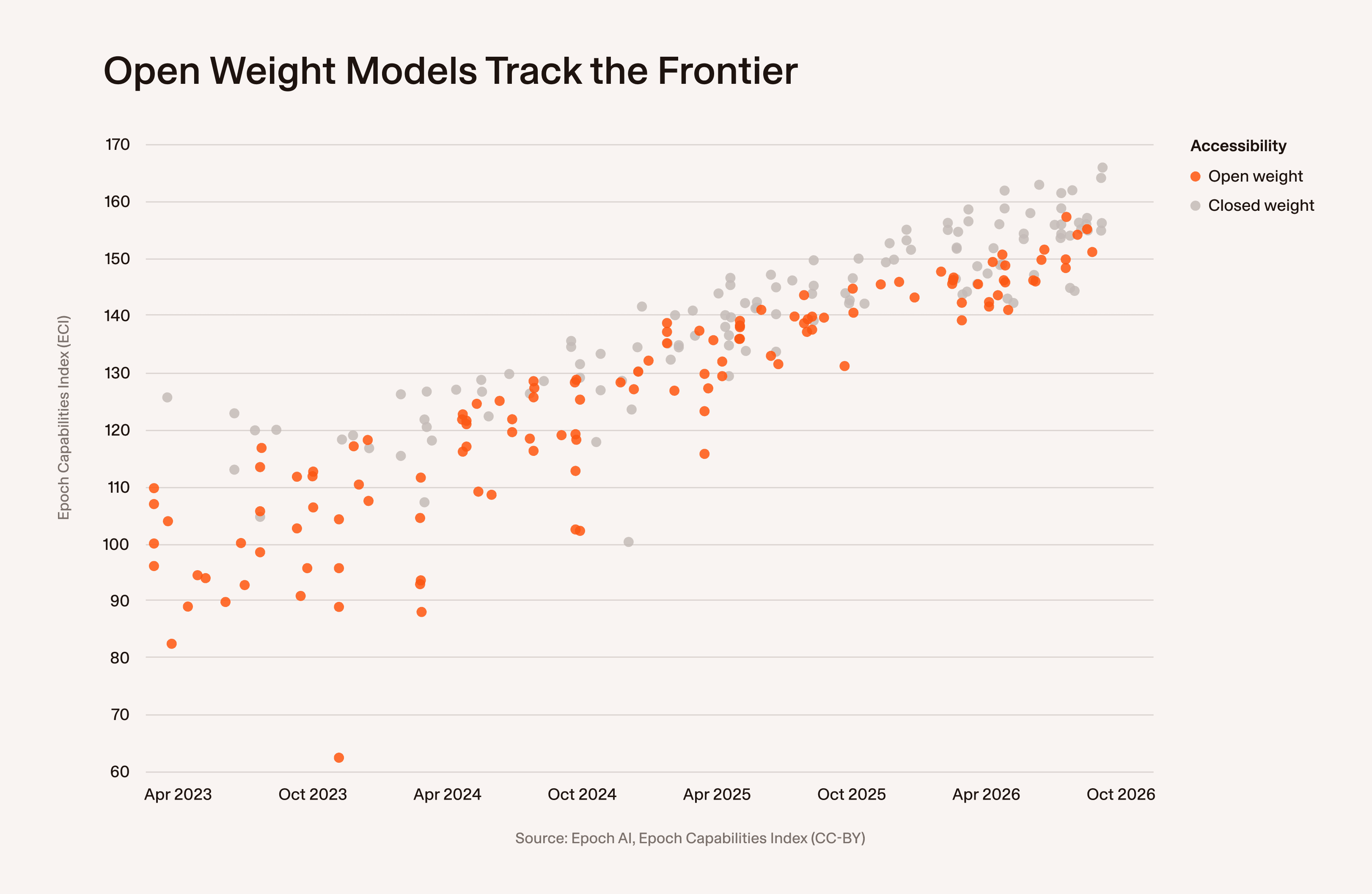
The Epoch Capabilities Index (ECI) by Epoch AI aggregates many benchmarks into one capability scale. The quality gap between open and closed models is closing rapidly.
Normalizing open weight model releases
Model openness runs on a spectrum. At the most open end, a release publishes weights, training data, and code under permissive terms, also known as the OpenMDW license. Most popular open weight models release weights alone, and for smaller labs in particular, that is a reasonable compromise, as it builds adoption and credibility while protecting the data pipelines and training methods that are their edge.
The permissive licenses that anchor the open end of the spectrum are themselves an American export. MIT, BSD, and Apache came out of American universities and foundations and became the default terms for open source software everywhere. Making them the default for model weights is what we must do next.
The opportunity is to make this the American standard, so that a model release means an open weight release unless there is a compelling reason otherwise. Each open weight model release further widens access to building with AI to the point where building with open models becomes the norm and not the exception.
Supporting the open source ecosystem that models are built on
Open weight models are only usable because of the shared software layer around them. Much of that layer was built in the United States. PyTorch, which trains most of the world's models, began at Meta and now sits under the Linux Foundation. vLLM, which serves them, came out of UC Berkeley. The benchmarks organizations use to verify a model's performance, from MMLU to Stanford's HELM, are American academic work, and Hugging Face, where the models themselves are distributed, is headquartered in New York. This infrastructure is the difference between weights being published and never used and weights being adoptable, and it exists because American universities, companies, and foundations chose to make it open.
To continue to advance an open weight future, we must keep our AI ecosystem open. Open source frameworks, repositories, datasets, benchmarks, and other artifacts must be properly maintained and must remain open. This requires treating them as public goods, funded by the labs and companies whose models would be unusable without them.
The United States carries a rich tradition of open source software and has played an outsized role in building the ecosystem that open weight models run on. Maintaining that ecosystem, and committing to keeping it open, means open weight models can be used and built on by organizations that could never have pre-trained one in the first place.
To build a country of many models
For years, the open versus closed debate has dominated the conversation around artificial intelligence. While important, this binary framing has hidden a second, equally critical axis of model diversity: large versus small. A healthy AI ecosystem recognizes that different problems call for different sizes of model, and that what fits one will not fit another. A country whose open models are all frontier-scale is still a country of only a few models.
Small open weight models are fast and inexpensive to run, and when fine-tuned on specific tasks they can match the performance of much larger models. Our own GLiGuard and GLiNER2-PII, each 300 million parameters, match or exceed the accuracy of guardrail and PII models up to 90 times their size while running up to 20 times faster. Small models are also optimized to run in resource-constrained environments, offering privacy and latency properties that larger models struggle to achieve. Building a country of many models must therefore include releasing capable open weights at every size, not only at the frontier.
The United States is already well positioned to succeed in this. Google's Gemma and NVIDIA's Nemotron together cover a wide size spectrum, from Gemma's phone-sized variants to Nemotron's 550-billion-parameter Ultra. Other labs focus specifically on small open weight models. Liquid AI's LFM models and our own GLiNER models are compact by design and offer accuracy that rivals models many times their size. To sustain this, American labs should continue to release open weight models at every size, prioritizing training models that not only compete at the frontier but also push forward the Pareto frontier, the best possible tradeoff between capability and cost.
The ecosystem this could be
Open weight model releases have exploded, with Hugging Face's Hub growing from one million models in September 2024 to three million in August 2026. This growth is forcing a decision on the country that is home to the most powerful AI labs in the world and where the term "open source" was first coined. America must choose whether to embrace open weight models or allow a handful of labs to control intelligence and access to it that may come to dictate our future.
We have argued that embracing open weight models, and the ecosystem around them, offers a set of interconnected opportunities: to rapidly accelerate innovation through cross-lab collaboration, to expand who gets to build with AI, and to create an ecosystem of open weight models with sizes and architectures for every task.
A future of American open weight models is well within reach. The models, the ecosystem surrounding them, and the labs capable of building them are already here. What remains is the choice to make openness the default rather than the exception.

Fastino Inc. (“Fastino”) develops specialized AI models and provides APIs designed to support structured data extraction, classification, reasoning, and production AI workflows. Fastino is a technology company and does not provide legal, financial, compliance, or advisory services.
Any outputs, predictions, classifications, or decisions generated through Fastino models are based on the configuration, data, and implementation provided by the customer. Fastino does not control, verify, or guarantee the accuracy, completeness, or suitability of model outputs for any specific purpose. By using this website or Fastino’s models and services, you acknowledge that all content and outputs are provided for informational and operational purposes only and agree to our Terms of Use and Privacy Policy.
2026 Fastino Inc.
All rights reserved